 Most viewed Most viewed |
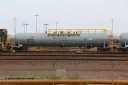
0031 CNR - QRRS China 150523 8212419 viewsNelson Point, empty 116 kL CNR-QRRS of China built tank waggon 0031, class leader of a second batch delivered in 2015 with safety slogan 'Safety - It's your life'.
|
|
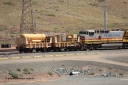
131122 3312419 viewsRio Tinto compressor waggon set CB 08, has been upgraded from the original Robe River compressor waggon set IC 22 with air receiver and IC 23 with two Atlas Copco XAS 97 units replacing the original Ingersoll Rand air compressors. These waggons are ballasted to 100 tonnes each and are modified ore waggons. Cape Lambert 22nd November 2013.
|
|
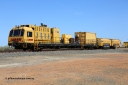
171121 0970419 viewsBarker Siding, Loram rail grinder MPC 2, this was sent out from the USA where it was operational as LMIX 602 for Loram. The generator and driving cab look to be fitted to an 85 foot piggy back waggon. 21st November 2017.
|
|
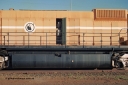
241-22419 viewsNelson Point, Mt Newman Mining's last in-service ALCo M636 unit 5499 serial C6096-4 built by Comeng NSW sits awaiting partial dismantling before being sent by road to Rail Heritage WA's museum at Bassendean, Perth for preservation. Drivers side view of the engine hood and fuel tank. June 2002.
|
|
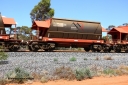
190107 0626419 viewsBinduli, on empty Mineral Resources Ltd iron ore train service from Esperance to Koolyanobbing 2034 with MRL's MHPY type iron ore waggon MHPY 00052 built by CSR Yangtze Co China serial 2014/382-52 in 2014 as a batch of 382 units, these bottom discharge hopper waggons are operated in 'married' pairs.
|
|
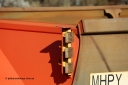
190109 1611419 viewsBinduli, Mineral Resources Ltd empty iron ore train 4030 with MRL's MHPY type iron ore waggon MHPY 00312 built by CSR Yangtze Co China serial 2014/382-312 in 2014 as a batch of 382 units, these bottom discharge hopper waggons are operated in 'married' pairs.
|
|
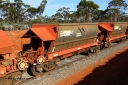
190109 1628419 viewsBinduli, Mineral Resources Ltd empty iron ore train 4030 with MRL's MHPY type iron ore waggon MHPY 00166 built by CSR Yangtze Co China serial 2014/382-166 in 2014 as a batch of 382 units, these bottom discharge hopper waggons are operated in 'married' pairs.
|
|
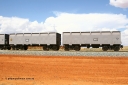
01255-02256 080124 1625419 viewsChapman Siding, new FMG ore waggon pair 1255 slave and 2256 control, built by China Southern or CSR at their Zhuzhou Rolling Stock Works in China in 2007. 24th January 2008.
|
|
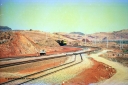
246-06419 viewsCape Lambert, yard view of the then new extension to the south for the West Angelas mine was coming on stream as a Robe River loaded Deepdale train arrives on the main behind the standard quad Dash 8 power with 202 waggons, the just visible siding (rejoining) on the far left will become a compressor waggon holding road, the 6 km and Boat Beach Rd grade crossing are around the corner to the left. Closest to the camera is the extended No. 1 Road which becomes the Empty Car Line from car dumper one for the Deepdale traffic. Next is the original line or Mainline and the third line across is the Loaded Car Line for the West Angelas traffic to the new car dumper 2. 22nd May 2002.
|
|
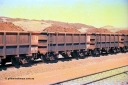
246-29419 viewsCape Lambert, a Robe River loaded Deepdale train rolls along the mainline with the normal 202 waggons which are a mix of builds from Nippon Sharyo Japan and Tomlinson Steel and Centurion Industries both WA companies. The ore is a ROM product and will be dumped over the gyratory crusher to be correctly sized. 22nd May 2002.
|
|
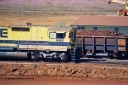
247-28419 viewsCape Lambert fuel point, Robe River Dash 8 power 9425 which is a Goninan WA ALCo to GE rebuild CM40-8M with serial 6266-8 / 89-85 from August 1989 riding on Hi-Ad bogies and was originally an AE Goodwin built M636 ALCo serial C-6041-4 and built new for Mt Newman Mining (later BHP Iron Ore) in April 1970 and numbered 5468, sold to Robe and delivered by road 17th August 1982. Everything below the frame is ALCo while above is GE and Pilbara Cab. Approximate location of the locos is here. 22nd May 2002.
|
|
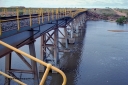
249-02419 viewsYule River bridge looking north from the 160 km on the BHP mainline. The third pier from the southern end was undermined by flood waters from Tropical Cyclone John in December 1999. The rail line was closed for two weeks while repairs were effected. Approximate location.
|
|
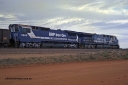
254-26419 viewsBing Siding at the 20 km, an empty train departs south with Goninan rebuild unit 5668 'Dunkirk' an CM40-8MEFI model with serial number 8412-01 / 95-159, one of the last four rebuilds with an EFI 7FDL engine. It is trailing AC6000 unit 6071. September 2001.
|
|
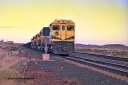
256-17419 viewsMaitland Siding, early morning loaded train waiting for a meet with an empty behind the quad CM40-8M working of 9414, 9420, 9410 and 9425. May 2002.
|
|
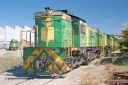
245-08419 viewsPort Lincoln loco workshops, still in former owner AN livery, Australian Southern 830 class locomotive 851 AE Goodwin ALCo model DL531 serial 84137 which has been on the Eyre Peninsula Division since being built in April 1962, stabled motive power over the weekend downtime. 6th April 2003.
|
|
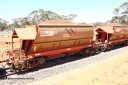
190129 4248419 viewsBinduli, on Mineral Resources Ltd loaded iron ore train service from Koolyanobbing to Esperance #3033 with MRL's MHPY type iron ore waggon MHPY 00061 built by CSR Yangtze Co China serial 2014/382-61 in 2014 as a batch of 382 units, these bottom discharge hopper waggons are operated in 'married' pairs.
|
|
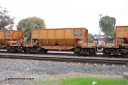
140601 4474419 viewsWoodbridge, empty Carina bound iron ore train #1035, CFCLA leased CHCH type waggon CHCH 7780 these waggons were rebuilt between 2010 and 2012 by Bluebird Rail Operations SA from former Goldsworthy Mining hopper waggons originally built by Tomlinson WA and Scotts of Ipswich Qld back in the 60's to early 80's. 1st June 2014.
|
|
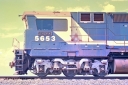
268-15419 viewsAt the 39 km detection site with the Alstom 25-year service agreement special, BHP Iron Ore's Goninan GE rebuild CM40-8M unit 5653 'Chiba' serial number 8412-10 / 93-144 stands on the Newman mainline with The Sundowner and 5634 on the rear of the train as the party conducts an inspection of the site. Friday 12th of April 2002.
|
|
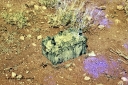
268-37419 viewsA battery that has been in a fire.
|
|
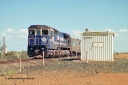
269-21419 viewsGoldsworthy Junction, and the Alstom 25-year service agreement special led by BHP Iron Ore's Goninan GE rebuild CM40-8M unit 5653 'Chiba' serial number 8412-10 / 93-144 heads back to Nelson Point with The Sundowner and 5634 on the rear of the train. Friday 12th of April 2002.
|
|
| 19260 files on 963 page(s) |
 |
|
|
|
|
|
|
|
643 | |
|
|
|
|
|
|
|
 Login
Login

